Why Attribution Matters More in Painting and Decorating
The painting and decorating sector has specific characteristics that make revenue attribution both more difficult and more valuable than in other trades.
Your customer lifecycle is longer and more complex than most businesses realise. An initial enquiry for exterior painting might convert immediately, but that same customer could return for interior work six months later, then recommend you to three neighbours over the following year. Without proper tracking, you lose visibility of that entire revenue stream.
Project diversity compounds the attribution challenge. A customer might enquire about a single room refresh through Google Ads, but during the quote process, the job expands to include hallway, stairs, and exterior woodwork. The final contract value bears little resemblance to the original enquiry, making it impossible to calculate true cost-per-acquisition without proper systems.
Seasonal demand patterns create another layer of complexity. External painting enquiries spike in spring, interior work increases in winter, and commercial projects often follow different cycles entirely. Understanding which marketing channels perform best during which seasons requires data that most painting businesses simply do not capture.
The Revenue Tracking Reality for Painters
Most painting and decorating businesses operate with a fundamental gap between marketing activity and revenue measurement. You know how much you spend on advertising, and you know your monthly turnover, but the connection between the two remains invisible.
This gap manifests in several ways. Phone enquiries dominate the painting industry, but without proper tracking, you cannot identify which online ads generated which phone calls. Form submissions from your website might capture some leads, but the majority of your business probably comes through direct phone contact that leaves no digital trail.
The quote-to-completion timeline makes attribution even harder. A customer might see your Google Ad in March, call in April, receive a quote in May, and book the work for July. By the time you complete the project and receive payment, the original marketing touchpoint is ancient history.
Many painting businesses compound this problem by treating each enquiry as isolated rather than part of a customer journey. The homeowner who books you for a bedroom refresh might return for bathroom painting, exterior maintenance, or commercial work at their business premises. Without tracking these connections, you undervalue the true lifetime impact of your marketing investment.
How CRM Integration Transforms Marketing Performance
A properly integrated CRM system closes the loop between marketing spend and actual revenue for painting businesses. Instead of guessing which channels work, you gain visibility into the complete customer journey from first contact to final payment.
The transformation starts with lead capture. Every enquiry, whether by phone or website form, gets logged with its source. Google Ads enquiries are tagged automatically, referrals are recorded with the referring customer's details, and repeat business is connected to the original acquisition channel.
Project tracking becomes revenue attribution. When that March enquiry converts to a July project worth £3,200, your system connects the final invoice back to the original Google Ad click. When the same customer books additional work eight months later, that revenue is attributed to the same source, revealing the true lifetime value of your marketing channels.
The data quality improves dramatically because everything flows through a single system. No more lost enquiries because someone forgot to log a phone call. No more duplicate follow-ups because multiple team members contacted the same prospect. No more missed opportunities because quote follow-ups fell through the cracks.
Integration with Google Ads and Meta automatically logs phone enquiries with campaign and keyword data. You can identify which specific ad groups generate the highest-value customers, not just the most calls.
Seasonal Pattern Recognition and Budget Allocation
Painting and decorating demand follows predictable seasonal patterns, but most businesses cannot optimise their marketing spend accordingly because they lack historical data with proper attribution.
External painting enquiries typically surge in spring and early summer as homeowners plan maintenance projects. Interior work often increases during autumn and winter when weather prevents outdoor projects. Commercial contracts may follow different cycles based on budget years and maintenance schedules.
With proper attribution data, you can adjust marketing spend to match these patterns. Instead of maintaining static Google Ads budgets year-round, you can increase spend ahead of peak seasons and reduce it during slower periods. You can identify which keywords perform best during which months and adjust bids accordingly.
The data also reveals counter-seasonal opportunities. Perhaps interior painting enquiries from Facebook Ads perform better in summer when homeowners are thinking about refreshing spaces before entertaining. Maybe commercial enquiries spike in specific months when facilities managers plan annual maintenance.
Historical attribution data enables budget forecasting based on actual performance rather than guesswork. You can calculate that increasing Google Ads spend by £500 in March typically generates an additional £4,000 in booked work by June, making the investment decision straightforward.
| Season | Primary Demand | Optimal Channels | Budget Allocation |
|---|
| Spring | External painting | Google Ads, local directories | 40% of annual spend |
| Summer | External maintenance | Facebook, referral incentives | 30% of annual spend |
| Autumn | Interior projects | Google Ads, social media | 20% of annual spend |
| Winter | Interior refresh | Local advertising, referrals | 10% of annual spend |
Measuring Lead Quality Beyond Volume
Most painting businesses focus on lead volume rather than lead quality, but attribution data reveals that not all enquiries are created equal. Some channels consistently deliver customers who book larger projects, pay promptly, and provide referrals. Others generate high enquiry volumes but low conversion rates.
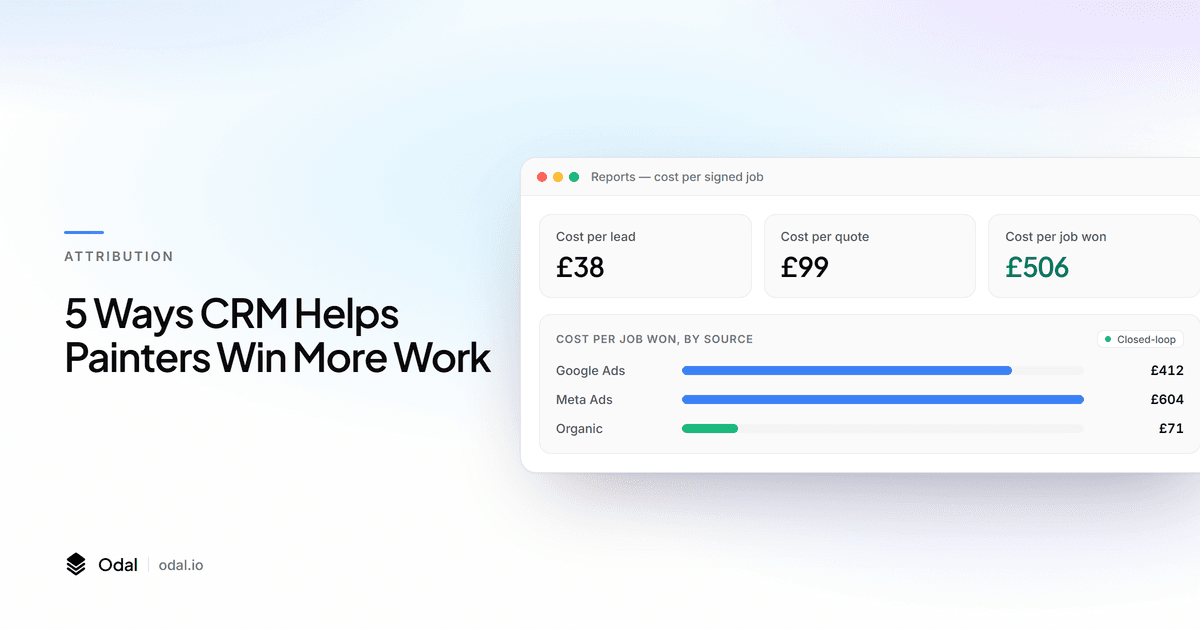
Google Ads might deliver 50 enquiries per month with a 25% conversion rate, whilst Facebook generates 80 enquiries with only 15% converting to actual jobs. Without attribution tracking, you might conclude Facebook performs better because of higher lead volume. With proper data, you can see Google Ads delivers more actual revenue despite fewer enquiries.
Project value attribution adds another dimension to lead quality assessment. Some channels consistently attract customers seeking premium services, whilst others generate price-sensitive enquiries for basic work. Understanding these patterns helps you allocate budget towards channels that align with your business model and profit margins.
Geographic patterns often emerge from attribution analysis. Google Ads might perform well for customers within 10 miles but poorly for those further away, whilst local directory listings generate enquiries from a wider area with better conversion rates. This insight helps you adjust targeting and budget allocation accordingly.
Repeat business attribution reveals the long-term value of different acquisition channels. Customers acquired through referrals might have higher initial project values and generate more repeat work over time. Those from certain online channels might be one-time buyers with lower lifetime value despite similar initial project sizes.
Implementing Attribution for Painting Businesses
Setting up proper attribution for a painting business requires connecting several data sources that typically operate in isolation. The goal is creating a single view of each customer's journey from first contact through project completion and beyond.
Start with lead source tracking for all enquiry types. Website forms should capture UTM parameters automatically. Phone numbers used in different marketing channels should be unique so you can identify the source of each call. Referral enquiries need systematic logging with details of the referring customer.
CRM integration connects enquiries to actual revenue. When you quote a job, the quote links back to the original enquiry source. When the customer accepts and you complete the project, the final invoice value attributes to the same source. Repeat business from existing customers connects to their original acquisition channel.
The system needs to handle the complexity of painting projects. Initial enquiries might be for single rooms, but final contracts often include additional work discovered during quoting. The attribution system should track project scope changes and final values rather than just initial enquiry details.
Calculating True ROI on Marketing Spend
With proper attribution in place, painting businesses can calculate genuine return on investment for each marketing channel rather than relying on assumptions or incomplete data.
The calculation becomes straightforward when you can trace revenue back to specific marketing activities. If Google Ads cost £1,200 last month and generated enquiries that converted to £8,400 in completed projects, your ROI is clear. But the analysis should extend beyond immediate conversions to include repeat business and referrals.
Lifetime value attribution provides the complete picture. A customer acquired through Google Ads for £50 might generate £2,000 in initial project value, return for £1,500 in additional work over two years, and refer three neighbours worth £4,800 combined. The true ROI calculation includes all attributed revenue, not just the first project.
Payback period analysis helps optimise cash flow and budget allocation. Some channels deliver quick conversions with projects starting within weeks of enquiry. Others have longer sales cycles but higher average project values. Understanding these patterns helps you balance immediate revenue needs with longer-term growth.
The data also reveals negative ROI channels that appear successful on surface metrics. A local directory might generate many enquiries at low cost per lead, but if conversion rates are poor and project values low, the actual ROI could be negative once you factor in time spent on quotes that do not convert.
Making Data-Driven Scaling Decisions
Attribution data transforms scaling decisions from guesswork into calculated investments. Instead of wondering whether to increase marketing spend, you can model the likely outcomes based on historical performance.
If Google Ads consistently delivers 4:1 ROI with current spend levels, increasing the budget by 50% should generate predictable additional revenue, assuming market conditions remain stable. The data shows you which campaigns, keywords, and ad groups deliver the best returns, enabling precise budget increases rather than blanket spending.
Geographic expansion becomes measurable. Attribution data reveals which areas generate the best customers and highest project values. When considering expansion into new territories, you can model costs and expected returns based on similar demographics and competitive landscapes.
The data also identifies capacity constraints before they become problems. If your Google Ads campaigns could profitably spend more budget but you lack the crew capacity to handle additional projects, you can plan recruitment or subcontractor relationships accordingly.
Seasonal scaling decisions improve with historical attribution data. You can increase spend ahead of peak seasons with confidence, knowing the expected return based on previous years' performance. You can also identify off-season opportunities that competitors might miss.
Ready to connect your marketing spend to actual revenue? Odal integrates with Google Ads and Meta to track every enquiry from click to completed project, giving you the attribution data you need to optimise your painting business marketing. Start your free trial and see which channels actually deliver the jobs that matter.
Frequently Asked Questions
How do I track phone enquiries from different marketing channels?
Use unique phone numbers for different marketing channels and implement systems that integrate with your CRM. Dynamic number insertion on your website can show different numbers to visitors from Google Ads versus Facebook, whilst maintaining a consistent experience.
What if customers take months to decide after getting a quote?
Long sales cycles are common in painting and decorating. Your attribution system should maintain the connection between initial enquiry source and final project completion, regardless of timeline. When a March enquiry converts to a September project, the revenue still attributes to the original marketing channel.
How do I handle referrals and repeat business in attribution?
Referrals should be tracked back to the original customer who provided the referral, and that customer's acquisition source gets credit for the referred business. Repeat business from existing customers attributes to their original acquisition channel, showing the true lifetime value of your marketing investments.
Should I track project scope changes in my attribution?
Yes, absolutely. Many painting projects expand from the original enquiry scope during quoting or execution. Your attribution system should track final project values rather than initial enquiry estimates to give accurate ROI calculations for each marketing channel.
How long does it take to see meaningful attribution data?
You will start seeing basic attribution patterns within 30 days, but meaningful trend analysis requires 3-6 months of data. Seasonal patterns become clear after a full year of tracking, enabling confident budget allocation decisions for future seasons.
What is the most important metric to track for painting business marketing?
Cost per acquired customer with lifetime value attribution. This shows not just the immediate cost of getting an enquiry, but the total cost of acquiring a customer who completes projects, provides repeat business, and generates referrals over time.